
Notícias
From shoe soles to asphalt: sludge from solvent recovery gains a new life in industry
Waste generated in the process carried out by RECICLO can be reused in the manufacture of rubberized items, industrial parts and applications in civil construction
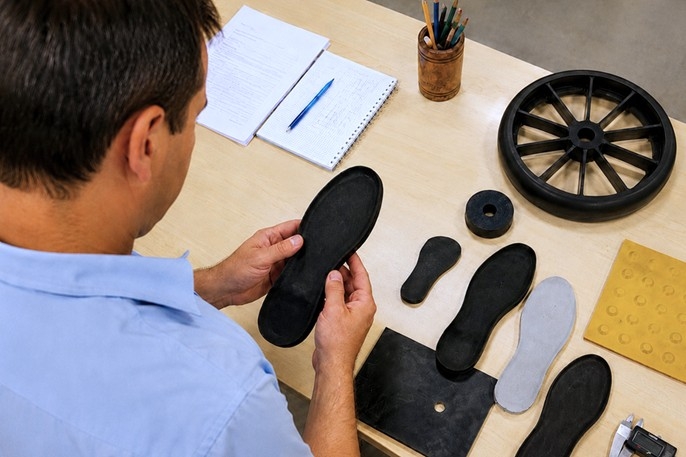
Industrial mats, insoles for footwear and even applications in the asphalt sector may have the same origin: the sludge generated in the recycling process of processors and solvents. In Santa Catarina, RECICLO Química, an industry specialized in the recovery of processors, industrial solvents and the treatment of chemical effluents, turns the leftover from a waste material into raw material for other industrial segments.
For 36 years, the industry has been recycling materials that previously generally went to disposal and, after treatment, begin to gain a new use. In the case of the sludge, the waste is generated from the engraving of printing plates used by the packaging industries. In the solvent recovery process, RECICLO uses distillation, in which the liquid part is evaporated and recovered, while the solid part concentrates at the base of the machine.
This leftover, with an appearance similar to rubber, is what is popularly called sludge. Instead of being sent to landfills, the material undergoes treatment and is sent to companies that reuse it in production processes or in the development of new products.
According to one of RECICLO’s chemical engineers, Carlos Eduardo Zappelini Nascimento, the treatment of the sludge prevents the waste from having an improper destination and allows it to return to the production chain. “We leave the waste in useful condition so that industry can reuse it in the production chain. It is in this sense that we are concerned with making use of almost 100% of the material that comes in here,” he says.
Applications of the sludge
Monthly, RECICLO produces between 27 and 43 tons of sludge. From this material, different industrial applications can be developed, such as rubberized mats used by people with visual impairments, wheels for small-load carts, supports for machines and equipment, mallets, bushings and insoles for footwear.
Reuse also reaches civil construction and the asphalt sector. “The manufacture of asphalt with photopolymers is an area in which many industries are investing, because this material increases the longevity of the asphalt pavement and the layer that covers it. Therefore, rubber and its derivatives, as well as the industry and the reuse of this material, are closely linked to companies’ ESG practices and the development of new technologies,” Zappelini points out.
In addition to the treatment carried out by RECICLO, partner companies reuse around 10% of the sludge in industrial operations. Internally, complementary stages are also carried out, such as cleaning, milling and shredding of the raw material, so that it can be used again in industrial processes.
 Voltar